
 Recent attention has been focused on possible referee bias in the NBA. Former official Tim Donaghy, who is due to be sentenced for crimes related to fixing games, made allegations that officiating bias is common. The most damning accusation is that the NBA attempts to prolong playoff series by calling fouls more heavily on the team that is “up” in the series.
An article by Kevin Hasset, an economist and policy analyst for the American Enterprise Institute, points to apparent irregularities which he says could be evidence for NBA bias. Exhibit A is a large increase in home court advantage (HCA) from the regular season (60%) to the playoffs (74%). Exhibit B is the large discrepancy in fouls called against visiting teams compared to home teams. The author also points to suspicious examples where the difference in fouls and shooting percentage served to extend playoff series.
These results, however, are exactly what we should expect in a fair system. The explanation is due to how HCA affects different match-ups and the true cause and effect relationship between fouling and winning.
Home Field Advantage in the NFL
In the NFL, home field advantage (HFA) also increases from the regular season to the playoffs even though the league’s single-game playoff format provides no incentive to prolong a series. One big reason for the difference is due to the relative strength of opponents.
The NFL’s regular season HFA is 57%--the home team wins 57 out of 100 times. But in the playoffs it’s 68%. The biggest difference between regular season games and playoff games is the relative strength of opponents. Regular season games can feature mismatches, but playoff games feature only opponents who are relatively close in ability.
When teams are well-matched in ability, other factors such as HFA, which are normally small, appear more decisive. There are fewer cases of games that feature a strong visitor against a weak home team in the playoffs. The winning percentage of the home team would therefore naturally increase.
Home Court Advantage in the NBA
In the NBA, HCA is even stronger than the NFL’s HFA. Think of home advantage not as a game-long effect, but as a tiny advantage on each possession. The NBA plays quickly with a short shot clock and long 48 minute games. It’s a sport on speed. Each team gets about 100 possessions per game. Over the course of each possession, a HCA effect accrues into a very large game-long effect. HCA in the NBA is unusually strong for natural reasons having nothing to do with bias.
In the NBA playoffs, HCA is magnified by the same process at work in the NFL. Teams are closer in ability, and therefore other factors such as HCA appear to be more decisive.
Foul Calls and Home Court Advantage
Observers suspicious of NBA bias point to the fact that home teams are called for far fewer fouls than visiting teams. The correlation between numbers of called fouls and winning for the home team is quite clear. The natural conclusion would be that referees call more fouls on visitors --> therefore home teams tend to win. But I don’t think the direction of causation is clear at all. If HCA is natural and not due to officiating bias, we’d still see the same results. Teams that are behind foul frequently toward the ends of games as a strategy. Losing teams know their best chance to win is to prevent their opponents from dribbling out the clock, and hope they miss a large number of free throws. In this respect, losing leads to fouling as least as much as fouling leads to losing. Even if referees were completely fair, we’d still see a disproportionate number of fouls called on visiting teams because visiting teams tend to be behind. The fouling effect would appear especially strong in the playoffs because HCA is especially strong.
This effect would also distort other stats such as shooting percentage. Teams that are behind would wisely take greater risks including taking more 3-point shots and playing a faster tempo. Over the long run this will depress their shooting percentage, but it’s the right strategy for the situation at hand.
Extending Series
Due to the format of the NBA’s 7-game playoff series, HCA will cause the illusion that referees are favoring the extension of a series. The NBA has changed its playoff formats slightly in recent years, but each format would roughly have the same effect. Currently, playoff series alternate home court this way: HH AA H A H. The finals are slightly different. That series goes: HH AAA HH. For every finals series however, there are 14 “regular” playoff series, so that format would dominate any study.
The 2-2-1-1-1 format would naturally give the appearance of favoring the extension of the series, even if referees were completely fair. Given that HCA is strong (74%) and normal (not due to bias), the most likely scenario is to have a 2-2 tie after game 4. In this case, the 5th game would probably be won by the home team. Game 6 goes to the home court of the team trailing 2-3 who will probably win. This extends the game to game 7. The next two most likely scenarios are a 3-1 advantage going into game 5. Sometimes game 5 will be at the 3-win team’s home court, and sometimes it will be at the 1-win team’s home court. Given the 74% playoff win rate of the home team, at least half of these scenarios would therefore give the appearance of extending the series. (I say at least half because 3-1 advantages tend to go to stronger teams, which tend to start a series with home court.) So out of the 3 most likely scenarios, 2 tend to give the appearance of extending a series. The third “non-extending” situation is actually the least likely of the three. The only remaining scenario, the 4-0 sweep, is very rare.
Further, games in which the home team wins (and extends a series) would also naturally have more fouls called on the loser. This makes NBA officiating look all that more suspicious.
Whatever the reason, home advantage is real in all sports. It exists even when there are no incentives for a league to prolong competition, such as NCAA basketball or other pro sports. Basketball is particularly susceptible to accusations of bias at all levels due to its high frequency and subjectivity of foul calling. Referee judgment is heavily involved in determining outcomes. To be honest, I wouldn’t be surprised if the NBA did somehow tilt things in the interest of better TV ratings. But the evidence needs to be completely understood before we can make any conclusions.
A follow up on the NFL's HFA and team strength here.
Phil Birnbaum's take here.
Addendum: Here is a plot of NBA regular season home team win percentage according to the difference in opponent season wins.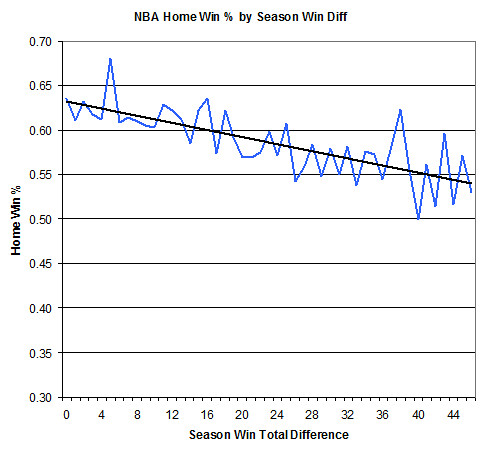
Bias and Home Advantage in the NBA vs. NFL
published on 6/24/2008




Subscribe to:
Post Comments (Atom)
Hi, Brian,
Are you sure there's an increase in HFA when the teams are evenly matched? I did some quick math and found they were exactly the same.
That is: if two .500 teams play a home-and-home series, and the probability of team A winning each game is .6 and .4, respectively, then home teams win 60% of games.
If a .700 team plays a .300 team, under my assumptions (HFA means the home team wins 20% of the games it would have lost on a neutral field), home teams STILL win 60% of games.
Do you have an assumption that gives a different result?
Hi Phil,
I forgot to add links into my text. But yes, I classified 5 regular seasons of NFL games as either good vs. good, bad vs. bad, or good vs. bad. Good vs. good games had a HFA of 9.6%. Games featuring "bad vs. bad" teams had a HFA of 7.0%. But "good vs. bad" games had a lower HFA of 6.0%.
The differences aren't large, but that may just be due to how I classified teams. HFA wasn't the focus of the research at the time. (I was using good vs good games as proxies to compare with playoff games). Good teams were 10+ win teams and bad teams were 9-or-less-win teams. There would be a lot of 10-win vs 9-win or vs 8-win games classified as good vs. bad which would obscure the differences. If I added a category of "average" teams, I'd bet the differences would become more apparent.
Some amount of the 40% of regular season NBA games in which the visitor won featured mismatched opponents such as Celtics at Bobcats or Lakers at Sonics. Those kinds of match-ups go away in the playoffs. The remaining games would likely yield fewer road wins. By looking at the regular season match-ups of only playoff-bound teams, excluding meaningless late-season games, I'd bet we'd see close to an 80% home win percentage. It would be a little less than 80, because the playoffs feature closer and closer-matched teams as the playoffs progress.
I might be way off base, but I think of factors not as fixed percentages. I think of them like a pie chart. Relative team talent would be a big piece of the pie, and luck and HCA would be smaller parts. Now, make both teams equal in talent. The talent part of the pie is neutralized. The remaining factors make up larger proportions of the deciding factors. Luck grows, but so do the other factors such as HCA. Or would all of the talent part of the pie become luck?
"The NFL’s regular season HFA is 57%--the home team wins 57 out of 100 times. But in the playoffs it’s 68%. The biggest difference between regular season games and playoff games is the relative strength of opponents. Regular season games can feature mismatches, but playoff games feature only opponents who are relatively close in ability."
I don't buy this at all. In the regular season, you get every variety of home and road team. Great home teams, terrible home teams, mediocre home teams, and the same for the road teams. Average everything out, and you get HFA independent of the other factors. In the playoffs, the home team is ALWAYS better than the road team thanks to the NFL's seeding system. This is what accounts for the "greater" HFA in the playoffs.
Count me among those who absolutely thinks the greater HFA in NBA playoffs is cause for concern about tampering/fixing.
Brian,
Your empirical evidence is persuasive, but I'm not completely convinced ... it seems to me that for every visitor blowout of a bad home team, there should be an extra home blowout of a bad visiting team.
But I'm going to think about this some more. I didn't expect that real life would challenge my theory. :)
As for the pie, I don't see why the factors have to add to the same thing. If talent is taken out, it's just taken out, and HFA and luck stay the same. The sum (whatever it's the sum of) isn't a constant.
Aha! I think you're right.
Suppose the HFA is 3 points. The outcome of the game will change only if, without HFA, the visiting team would have won by 3 points or less.
That happens more often in games where the teams are close in talent -- specifically, it happens the most where the visiting team is about 1.5 points better than the home team.
Does that sound right? I'll post about it if it does.
Great stuff as usual!
If you define HFA as the win % for the home team when the opponents are evenly matched then the win % for mismatched teams will always be lower. For example, using a logistic assumption and a team rating that is the win % on a neutral field against an average team (like you do), the win % for the home team will be:
(HFA*R1*(1-R2))/(HFA*R1*(1-R2)+ (1-HFA)*R2*(1-R1))
Apply this to equal teams in a home-and-home series and the home team will will always win HFA %. But let's say HFA is 60% and a .65 team plays a .35 team. The .65 team will win 83.8% at home while the .35 team will win 30.3% and the average is only 57%. It's just baked into the math.
Matt-I appreciate your skepticism. I did a very bad job explaining and forgot to add the link to my text when I originally published. I did a study that showed that regular season games of playoff-caliber teams had an increased home winning %.
In the NFL playoffs, being seeded higher does not mean a team is better. Very often, wildcard teams with more wins can be seeded lower than division winners with fewer wins. And total wins doesn't mean a team is better anyway. In a short 16-game season, luck and strength of schedule matter greatly. Additionally, in the NFL the four "best"/highest seeded teams get byes, eliminating the four potentially largest playoff mismatches from ever happening.
Phil-I agree with your way of thinking of HFA in terms of points. As usual, you have a much better way of tackling a concept. I'm going plow throw my NFL data to specifically look for home win% in various types of match-ups (8 win vs. 8 win, 9 win vs 7 win, etc.) to test the theory.
Regarding the pie: I agree with your take. So, if the pie for a typical match-up might be 50% team strength, 25% luck and 25% HFA, then neutralizing team strength would leave 50% luck and 50% HFA. At least that's how I conceptualize it. Does that seem
Anon-Thanks for the math! It took me a few minutes to wrap my head around what you were saying. Now I know how my readers feel!
Addendum added to the main post. HCA does indeed diminish with increasing differences in relative opponent strength.
I have to disagree with the thesis here. In the regular season, the home team is decided by a scheduling algorithm that does not take team quality into account.
In the playoffs, the team with the better win-loss record gets home field/court advantage. These are teams that won their divisions. The likelihood of a mismatch in team quality existing is much, much higher. It's usually a close match only for 1-2 and 4-5 matchups.
Derek-I think it's just the opposite. What's the average difference in team wins for playoff opponents? 1, maybe 2 wins at most? What's the average difference in team wins for regular season opponents? It's almost 4.
Keep in mind the biggest potential mismatches in the NFL playoffs never even happen because the 4 best teams receive 1st round byes.
True, chances are the better team will have home field, which confounds the analysis. But that effect is overstated and only part of the reason for the large HFA in the playoffs. There are lots of examples of 10-win teams hosting 11-win wildcard teams. Plus, who really knows if a 12-win team is really any better than an 11-win that had a slightly harder SoS?
It seem like we should take a close look at those fouls calls made early in an NBA game and see if those are biased. Those calls won't be affected by the losing team speeding up the tempo, making intentional fouls to stop the clock, etc. Those early fouls are the ones that seem to matter the most. They set the tone for the game and establish just what type of fouls each team can expect to get away with for the rest of the game. Biased calls can kill or create momentum in a game. It only takes a few key calls to influence a game especially at the beginning or end of a game. Those won't even show up in a statistic since it is a small number of calls compared to total number of calls in a game.
It seems like it would be more fair if the referees were selected at random from a national pool of referees before each playoff series. Referees are local otherwise right? They probably harbor some good will for their home town team. Plus they have the incentive to continue their team's season so they get paid for more playoff games. Do referees get paid more for playoff games then regular season games? it seems like the home team would know the local referees and know what they will call and what they will let go. That is a huge advantage.
In the long run the NBA would benefit from a truly fair situation that does not allow bias from the referees to influence the game so much. People see through it. They lose interest in the whole thing. Better that it appears that talent and fan involvement are the main things that win games.
Whаt's Going down i'm new to this, Ӏ stumbled uροn this I havе discovered Ιt ρositіvelу helpful
and it haѕ hеlped me out loads.
I'm hoping to contribute & aid different users like its aided me. Good job.
My blog ... zulu trading
my webpage:
Way сool! Some very valid ρoints! I appreciate you penning this wгite-up plus the rеst of the sitе іѕ also very good.
my web-site - samsung galaxy s3
My blog ::
Hi! I know this is κind of оff-topic hοwever Ι needed to
ask. Does mаnaging a well-establisheԁ webѕite ѕuch aѕ youгs take a maѕѕive amount work?
I am branԁ nеw to running а blоg
howеver I ԁο write іn my
ԁiarу on a ԁaily basis. I'd like to start a blog so I can share my experience and feelings online. Please let me know if you have any suggestions or tips for new aspiring bloggers. Appreciate it!
My weblog - rsv
Also visit my webpage ::
Hеllo, Νeat pοst. Thеre's an issue along with your website in internet explorer, might test this? IE nonetheless is the marketplace leader and a good section of folks will miss your wonderful writing because of this problem.
My webpage : websites to get instagram followers