
 With 4 minutes left in the first quarter of last week's Cardinals-Seahawks game, Arizona's Neil Rackers booted a short but high 'pooch' kick that was quickly recovered by the kicking team. The kick recovery was worth a very considerable +0.12 WP. The Cardinals went on to score a touchdown, taking a 14-0 lead. How smart are onside gambles like this?
Onside kicks in the NFL are successful 26% of the time. It’s true, but it’s also very misleading. Onside kick success rates are very dependent on whether the receiving team is expecting one.
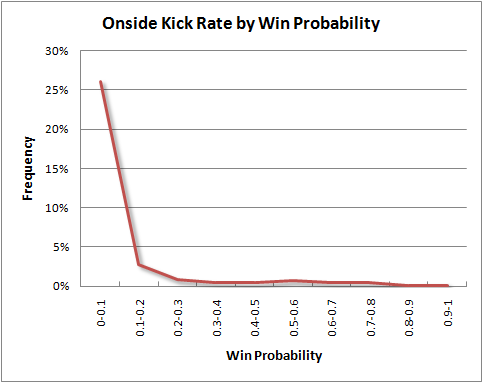
As you can see in the chart below, a plot of the frequency of onside kicks by win probability (WP), teams don’t usually attempt onside kicks unless they’re pretty desperate. Teams typically attempt them when they have less than a 10% chance of winning. Even then, they only do it about 26% of the time.
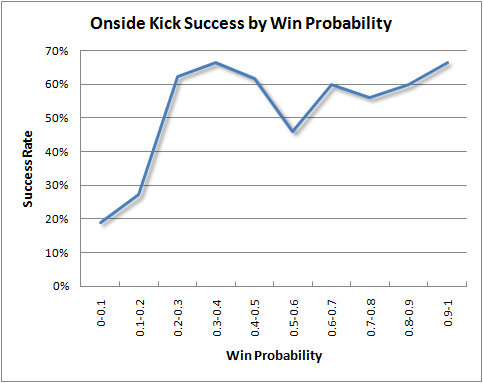
The effect of surprise on the success of an onside kick is pretty big. The chart below plots success rate by WP. The less a team is expecting an onside kick, the more successful it is. When teams are expecting it, when WP is about 0.15 and below, the success rate is about 20%. But when teams aren’t expecting it, the success rate averages 60%. (There are 103 onside kicks classified as 'surprise' in the data, which results in a standard error of +/- 4.8%.)
What does this mean for surprise onside kicks? Are they worth the risk given a 60% success rate? We can answer that question with an analysis based on Expected Points, the average of next points scored for first downs at each yard line on the field. In the following example, I’ll solve for what the break-even success rate would be for an unexpected onside kick.
The EP for a failed onside attempt is -2.1 pts, and the EP for a success is +1.2 pts. At first glance it appears onside kicks are always losing propositions. But don’t forget that you’ve always got to kickoff somehow, and a normal kickoff averages -0.7 pts for the kicking team.
EP(onside recovery) = +1.2
EP(onside failure) = -2.1
Let’s call the success rate ‘x’. Solving for the break-even success rate, where the combined expected points of an onside kick equal that of a normal kick, we get:
1.2x - 2.1 +2.1x = -0.7
3.3x = 1.4
x = 42.4%
So 60% is a lot more than the break even success rate of 42%, and as long as a team has the element of surprise, onside kicks are well worth the risk—at least under ‘normal’ football conditions. Late in games, however, depending on the score and time remaining, we can’t use the EP analysis anymore. We need to turn to win probability analysis, something I’ll look at in part 2 of this article.
 The catch is that teams can’t do this very often. The key is that the onside attempt is unexpected. As soon as a team is known for sneaky onside kicks, its success rate will go down. But this isn’t such a bad thing. As opponents are forced to respect the threat of an onside kick, their normal kick return blocking will suffer, allowing overall net kickoff distance to improve. Ultimately, there would be an equilibrium, making life more difficult for the receiving team.



This is great work. Its a topic I've thought about a bit and have always wanted to study more deeply.
I'm sure readers of this blog have heard of Pulaski high school in Arkansas. The coach is famous for never punting. He is also famous for trying an onside kick everytime.
The math is somewhat dependent on the fact that high school kickers can't kick as far and opposing teams special teams don't practice covering onside kicks as often as NFL teams do. So the math is not directly comparable to the NFL. Yet its still an interesting story because I think he has the math right and his opponents don't.
I'm especially interested in the game theory and equilibrium issues that would be involved in running a "surprise" onside kick far more often....say around 20% of the time. The biggest difference between a surprise onside and an expected one is the receiving team's personnel. They replace the big blockers with small wide receivers. If a team ran "surprise" onside kicks more often, they could always change the call at the last minute. If hands guys are on the front line, kick away. If not, go through with it.
The other problem from an adjustment point of view is preparation time. Say there is one team that surprise onsides 20% of the time and all the others do it 1% of the time. Clearly, when you are getting ready for that one team, you should prepare for it more often. What does that mean in real life though? Special teams units don't get as much practice time as most of the players have other responsibilities. How much time can you dedicate to a trick play you are likely to see only so often? Also, from one team's perspective, getting another team to spend more time preparing to stop a gadget play has real advantages in the corollary that they spend less time preparing for everything else.
Do you have the stats on onside kicks in the 1st half when it is a surprise?
I notice there is a dip in success rate right at 50%-60% chance of winning. Is this random, or does this represent teams trying an onside kick at the start of the game, where the surprise onside kick may not be as surprising as say, with 4 minutes left in the first quarter?
Do you have the data separated out by kicks at the start of a game/half (when coaches can prep the players coming in on both sides), versus after a score when the kicking team isn't in a very low WP situation?
How have the new restrictions on onside kicks this season affected success rates?
JKL-That was my thought too. I ran the numbers on this a few months ago, and I have to dig it up to check. I'd theorize the receiving team is more alert to the onside possibility at the beginning of the game, and as they fatigue they are less alert.
Anon-It's too early to tell. The numbers in this article don't include 2009.
As ever in the NFL one massive key to success is misdirection, making the opponent think you're doing one thing when you're actually doing something else.
It's amazing to think that after all these years, it seems coaches are operating way off the equilibrium for onside kicks. As you showed in another post, they're pretty close to equilibrium in run:pass ratio on third downs. I wonder if coaches are starting to read these blogs, what with the number of 4th down attempts seeming up so far this year, and whether we'll soon see coaches taking even more risks as it's shown that it's worth it in some situations.
According to Pro Football Prospectus 2007, "surprise" onside kicks had a 71% success rate from 1996-2006.
Interesting. How was "surprise" defined?
I'm guessing based on the behavior of the receiving team. If they have a deep guy and blockers, they were expecting a regular kickoff. If they are crowding the line, with maybe one guy deep, they were expecting an onsides.
But Pro Football Prospectus probably just used some guy's opinion.
I'm looking at the PFP 2007 article, and I don't see a definition of what makes an onside kick a "surprise." Their numbers are: from 1996-2006, there were 78 surprise onside kicks, 55 of which were successfully recovered (71%), and 516 expected onside kicks, 85 of which were successfully recovered (16.5%). They say that the break-even point for a surprise onside kick is 62% (rather than 42%): successful recovery at your own 40 is worth .94 EP, failure to recover giving the other team the ball at your 40 is worth -2.13 EP, and kicking deep on average gives the other team the ball at their 27.4 which is worth -.24 EP.
That's weird. The difference in the break-even success rate is just due to different EP values. I'm not sure how they derived those, but they are very different from the others I've seen.
Based on Levitt/Kovash EP values:
Success=+1.7, Fail=-2.3, Deep Kick=-0.6
Break even = 43%
Based on Romer EP values:
Success=+1.5, Fail=-2.4, Deep Kick=-0.6
Break even = 46%
Vince-Forgot to say thanks for digging that up.
I think Sean Payton reads your stuff, Brian. He told the media after the super bowl that he thought the chances of recovering that onside kick in the super bowl were around 60%-70%. From most of the stuff I read after that, everyone thought he was full of crap and just really lucky.
Of COURSE, most people "thought he was full of crap and really lucky." That derives from the fact that a large majority of football fans and even real football men are so tradition-bound that they refuse to acknowledge that they refuse to acknowledge the math, even when it whacks them upside the head.
Can't wait to see some statistical analysis of the new playoff OT rules. Seems to me that for the team that loses the toss the best percentage play would be to try an onside kick to start the OT.
What most people don't know, but should is that football is like a coin that has two sides. Everyone knows the universal truth of the first side of the coin that says that a team that scores more points than the opponent always wins. What people don't know is how a team lost a game without factoring the score. The other side of the coin would say that the team with the most real turnovers always losses the game. Statisticians do not count all events that turn the ball over without first scoring atleast 6 points. If they did they would see that the team with the higher number always losses. Try this with any game and you will see that it works:
Complete Turnovers: Interceptions, fumbles lost, missed fg's, punts, 4th down fails, kickoffs lost, safeties, and turnovers due to time (given if the team in possesion at the end of the half failed to score and has to kick to start the second half. Not counted if another turnover half or whole occurs at the same time. Also when the game ends and the team trailing fails to score before the time expiresn not counted against the team with the lead. also nullified if another turnover takes place.
Half Turnovers: Failed extra point or 2pat, Successful field goal, 2point conversion allowed.
Time to look at the implications of the new league rule on kickoffs--they've moved up, which means less risk in doing a surprise on-side kick, yes?
But, anon, it also likely means that the average EP allowed from a kickoff (which is usually a touchback now) have gone down, too.
How often does the receiving team score after recovering an onside kick?
How often does the receiving team score after recovering an onside kick?
The breakeven recovery rate is only 30% if you kickoff from the 50 (following a personal foul on the scoring play or XP) which is not that uncommon.
Using 2.5 expected pts for gaining possession at 40 yards to go, vs 1.2 lost expected pts for giving it with 60 yards to go.
I assumed that any team could elect to get a touchback with no risk so the opportunity cost is actually only 0.1 EP for a drive starting with 80 yards to go. Vs the above example this works against you as the normal kickoff is a much less risky play for the kicking team.
Packers had a chance to kickoff from the opp 45, and elected to go for a sky kick rather than a touchback.
Very interesting, I googled looking for statistics on onside kicks and I was pleasantly surprised to find this great breakdown.
Can the probability of winning an expected onside kick followed by a touchdown and followed by a two point conversion be calculated? The fans of the Packers would, I'm sure, be interested.
As with numerous matchups highlighting Nadal nowadays, this one will pit late memory versus ancient history. On the off chance that you take a gander at the last meeting top dog sports tennis between these two, you need to support Nishikori.